Martin Davorin Jagodić (1935 – 2020) was a Croatian composer and educator, who studied under Milko Kelemen, among others, before relocating to France in 1960 to study under Olivier Messiaen, eventually landing at Groupe de Recherches Musicales, where he worked between 1967 to 1969.
BUY
12″ LP VINYL
CD
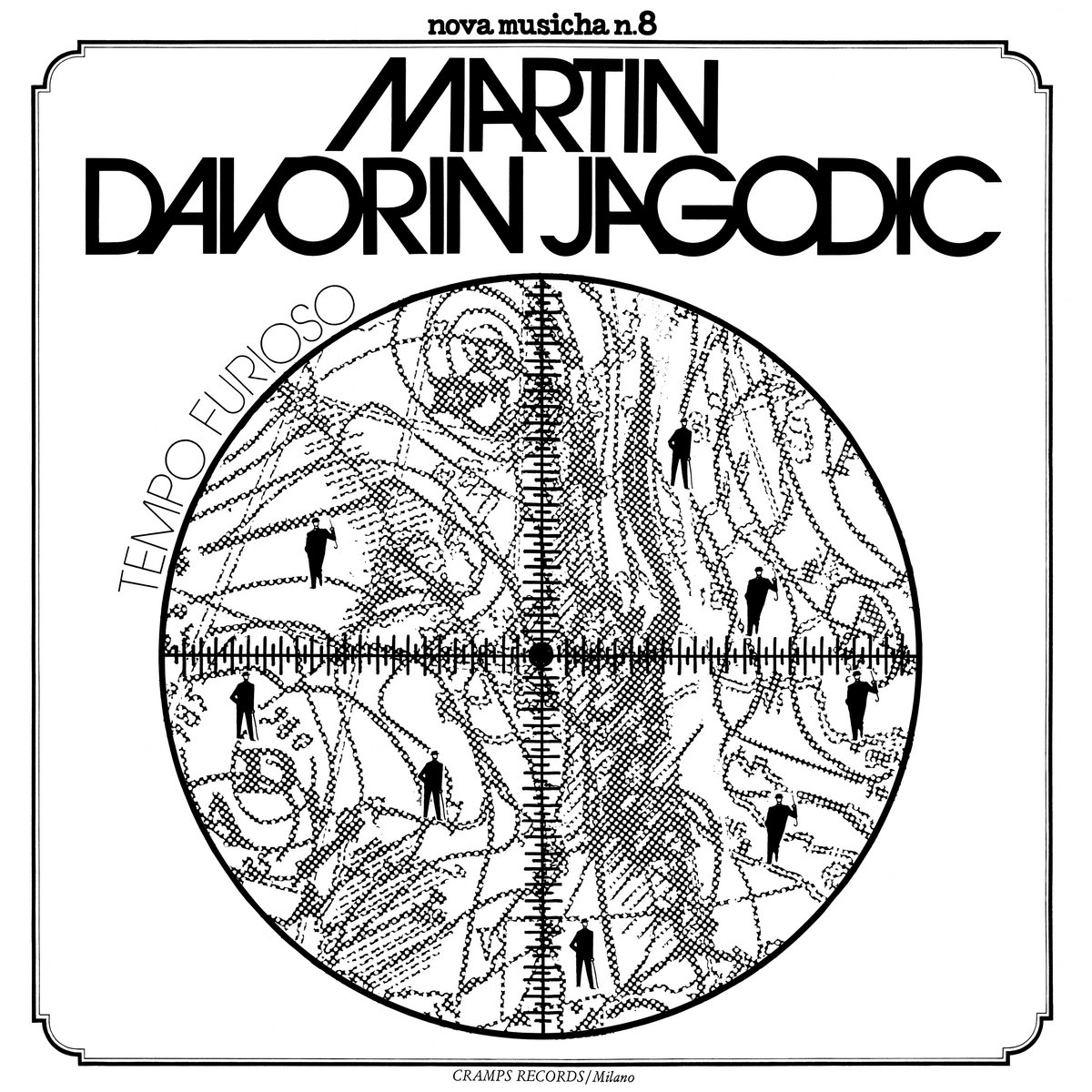
Over his long career, he collaborated with John Cage and various painters and film makers, and composed for theatre, multimedia installation art, experimental film soundtracks, radio art, electroacoustic music, musique concrète – often incorporating video, film and slide projections into his performances – but sadly only produced one album, Tempo Furioso (Tolles Wetter), issued in 1975 by Cramps as the 8th instalment of the their Nova Musicha series.
Tempo Furioso (Tolles Wetter) is an electroacoustic work that incorporates elements of radical approaches to electronics and musique concrète, including found sounds into its two long movements (one for each side of the LP). In his liner notes for the original edition – now translated into English for the first time by Dialogo – Davorin Jagodić likens the work, one of many possible manifestations of its open structures – to a storm unsettling a listener who resides in the safety and warmth of their home; the infiltration of naturally encountered sonorities demanding to be heard – “wood creaking, wind blowing, as well as lines connecting us with the outside world, far away as it might be (radio stations, for instance).”
Launching with marked intensity, across its early moments Tempo Furioso (Tolles Wetter) immerses the listener within an intricate tapestry of far-out electronic sounds, before gradually moving toward an incredibly complex and diverse pallet of found sounds, incorporating field recordings and broadcast sounds – static, speech, and numerous fragments of music – that intersect and collide like a transnational radio placed in various environments and spun out of control, culminating the first side with a cacophony built around an unknown document of free jazz.
By contrast, the second movement of Tempo Furioso (Tolles Wetter) is no less ‘musical’ but defined by large passages of intricate, restrained sound collage built around delicate field recordings of various environments, penetrated by vocal and electronic interventions, as well as various, fleeting presences drawn from the industrialised world. Sonically engrossing, creatively brilliant, and metaphorically rich, it is within these moments that Davorin Jagodić’s true talent and bravery as an artist become impossible to ignore.
Offering a long overdue reappraisal to one of the most fascinating and under-acknowledged artists associated with GRM during the ’70s, Dialogo’s beautiful vinyl reissue of Martin Davorin Jagodić’s Tempo Furioso (Tolles Wetter) couldn’t be more timely or welcome, illuminating a missing link between the Parisian attitudes toward electroacoustic practice, and the electronic innovations of contemporaries like Stockhausen. Issued in a limited edition of 300 copies on black vinyl, with fully remastered audio, housed in a gatefold sleeve that beautifully reproduces the original design, complete with brand new English translations of the original liner notes, we all owe Dialogo a great debt for bringing it back to our ears. Don’t sleep. It’s not going to sit around for long.
Tracklist LP: Side A: Lato A (B) 20:10 Side B: Lato B (A) 23:00
COSTIN MIEREANU ALBUM – DIALOGO Of all the seminal figures that recorded for Cramps, the Romanian / French composer, Costin Miereanu, remains among the most distinct and under-appreciated.
BUY
12″ LP VINYL
DIGITALE
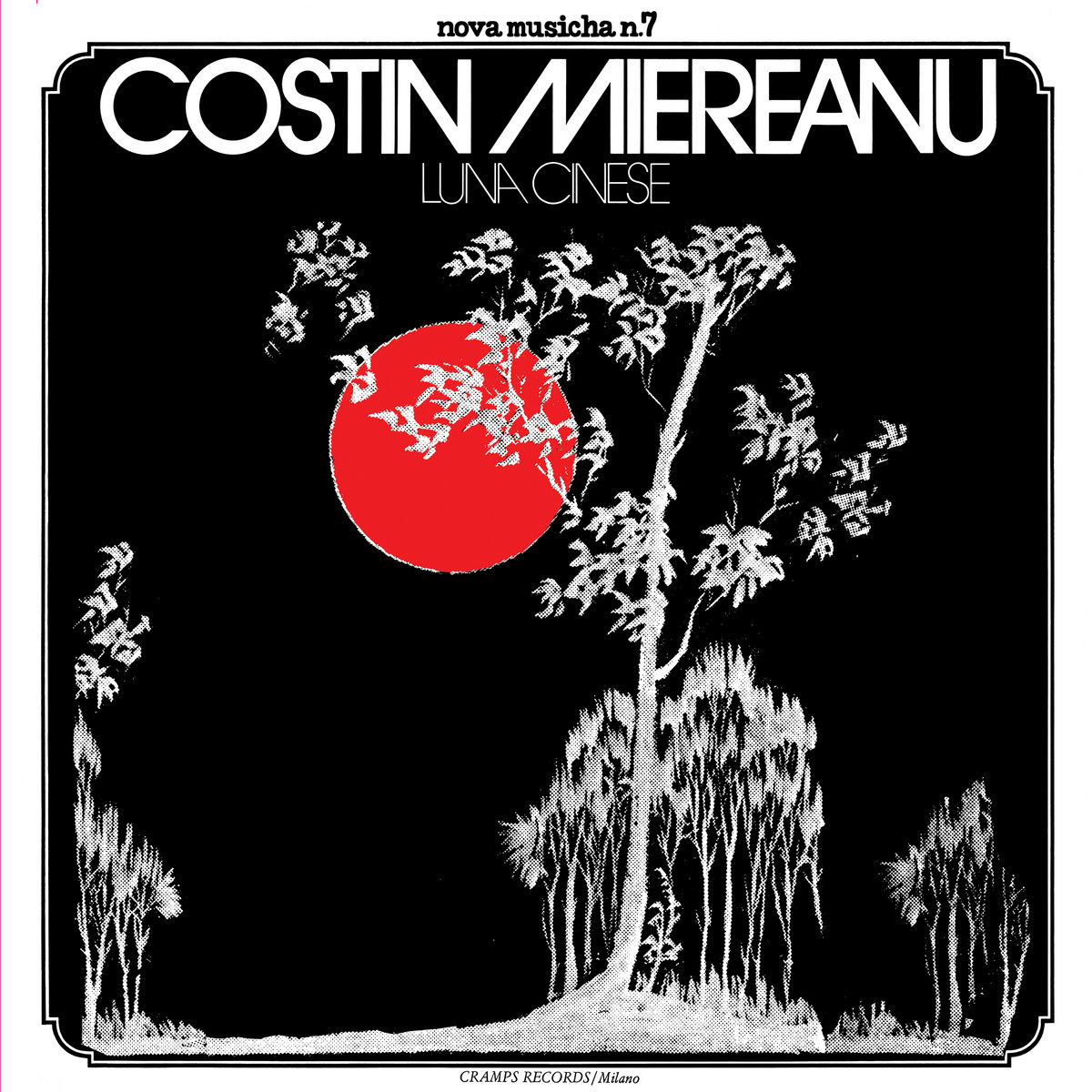
The reemergence of his debut LP, Luna Cinese, issued by the label in 1975, will likely change that.
Over the last decade or so, Miereanu has developed something of a cult following among experimental fans because of his stunning series of albums issued during the 1980s on his own Poly-Art imprint, skirting the border of ambient music and minimalism in highly individual ways. Luna Cinese, which dives into far more explicitly experimental territory, will undoubtedly be a revelation and expose the true underpinnings of the work that would begin to emerge in the next decade and a half.
During his early years, Costin Miereanu was something of a wunderkind of avant-garde and experimental music.
Born in Bucharest, between 1960 to 1966 he was a student of Alfred Mendelsohn, Dan Constantinescu, and Lazar Octavian Cosma, before moving to Paris where he earned a Doctor of Letters and a Doctor of Musical Semiotics, winning numerous prizes in writing, analysis, music history, esthetics, orchestration, and composition.
Between 1967 and 1969 he was a student of Karlheinz Stockhausen, György Ligeti, and Ehrhard Karkoschka at the Internationale Ferienkurse für neue Musik in Darmstadt, laying the final groundwork for a stunning career as both a composer and noted academic over the years since, often combining techniques drawn from Satie with the abstraction of Romanian traditional music into a sonic fabric that is guided by systems associated with Musique concrète.
Luna Cinese, issued as the composer’s debut LP by Cramps in 1975, is a stunning combination of all these elements. The work – stretching across the album’s two sides, consists of continuous low-density repetitions, built from what the composer describes as “the kind of ‘woven’ silence you find on mountains – occasionally disturbed by irregular and very dense insertions – the kind of intense noise you find in the city.” The result, combining a vast range of environmental sound, voices chattering in various languages, fragments of acoustic instrumentation, and the pulsing and ambiences of synths and electronics, is about as singular and beautiful as experimental works from the 1970s come, while never for a moment sacrificing rigour or tension.
A truly stunning, interwoven sonic expanse that lays pregnant with multiple meaning and interpretations – conceived by the composer to illuminate the complex ways in which meaning and narrative are constructed across time – and imbued with surrealism and the ‘schizoid’, Luna Cinese stands as an entirely distinct and original gesture within the canon of experimental music, displaying a remarkable density, while open, airy, and encouraging the subjectivity of the listener to play an active part.
Easily among the best and most important works from the original Cramps catalog, but sinfully overlooked over the years since its release, Luna Cinese is as good as they come and an absolutely riveting and immersive listen. Issued by Dialogo in this newly remastered vinyl edition – the first since 1975 – with its original liner notes by Miereanu in a brand-new English translation, this one is impossible to recommend enough and will leave the composer ringing in your mind for a long time to come.
Tracklist LP: Side A: Lato x opp. y Parte Prima (Seconda) 20:53
Phresoul are back! After The World Was Made Phresh (2019), Hyperjazz Records is now keen to present three new instrumental tracks by one of the most interesting bands in the actual music scene.
Unusually for the label, this work is a video shooting recorded in Fattorie Acustiche Studio, Reggio Emilia.
A new format that blends music, video, and the real act/art of “doing music”.
‘Brazilian Nightmare’, ‘Arnold’, and ‘A16’ are three instrumental tracks that perfectly embody the desire for exploration and never-ending evolving of the Italian duo.
BUY
DIGITAL ALBUM
This time, Phresoul went into the vast world of sampling– involving the deejay and scratcher TJ Scratchavite – and they tried to recreate a hybrid synthesis of analog and digital grooves. Phresoul | Studio Session is a sort of limbo, which perfectly reflects Hyperjazz’s intentions to define a new way of conceiving rhythmic music in the currents times. Out on 23rd of July 2021, it will be available also in all digital platforms and Bandcamp.
Phresoul project was originally a trio consisting of Charlie Stacey, David Paulis, and Enrico Truzzi. After their first EP ‘The World Was Made Phresh” on Hyperjazz Records, Stacey left the group. Its name takes direct inspiration from a Sun Ra sentence: “So I play phre music – music of the sun”.
David and Enrico have created an ensemble that tries to take down the traditional rules of jazz, continuously absorbs new influences and sounds, and portrays the contradictions and conflicts of our times.
Phresoul is a group that can be modulated as required and that looks to improvisation as a great possibility to create something different and truly personal. A young band – made up of young elements with very clear ideas – determined to take on an important role in the process that has seen jazz at the center of a cultural and sociological revolution/ evolution for some years now on a global level.
TJ Scratchavite A cassette tape player and a screwdriver deeply connect TJ Scratchavite with improvisation and sampling. Based in Mantua, and inspired by the American DJ Ruthless Ramsey, he is among the few in the world to have used the scratching technique on magnetic tapes. Growing up and living in hip-hop belief, he constantly experiments with the art of scratching in several music contexts.
Credits: Drums: Enrico Truzzi Bass & synth bass: David Paulis Scratch: Lorenzo Faglioni Video Shooting: Luca Moretti, Matteo Bigi Editing: Luca Moretti
Born in 1931 and active for roughly three quarters of a century, Alvin Lucier is a living legend and a treasure of the American musical avant-garde. It is impossible to overstate his importance.
BUY
12″ LP VINYL
DIGITAL
He is a towering pilar of intellect, creativity, and beauty who has yielded unparalleled influence with a body of work that has plumbed the depths of acoustic phenomena and auditory perception, exploring the resonance of spaces, phase interference between closely tuned pitches, and the transmission of sound through physical media, rising with unparalleled subtly innovation, and poetic depth.
Lucier belongs to a generation of composers who emerged during the early 1960’s, inheriting, but not beholden to, a landscape in constant creative and conceptual flux, contending with the challenges put forth by predecessors like John Cage.
With David Behrman, Gordon Mumma and Robert Ashley, he founded the legendary collective the Sonic Arts Union in 1966, all the while sculpting a singular and unparalleled body of work, focused around acoustic phenomena and auditory perception, which included, among many others, the groundbreaking works like Music on a Long Thin Wire and I Am Sitting in a Room, each quietly shifting the understanding of what music could be.
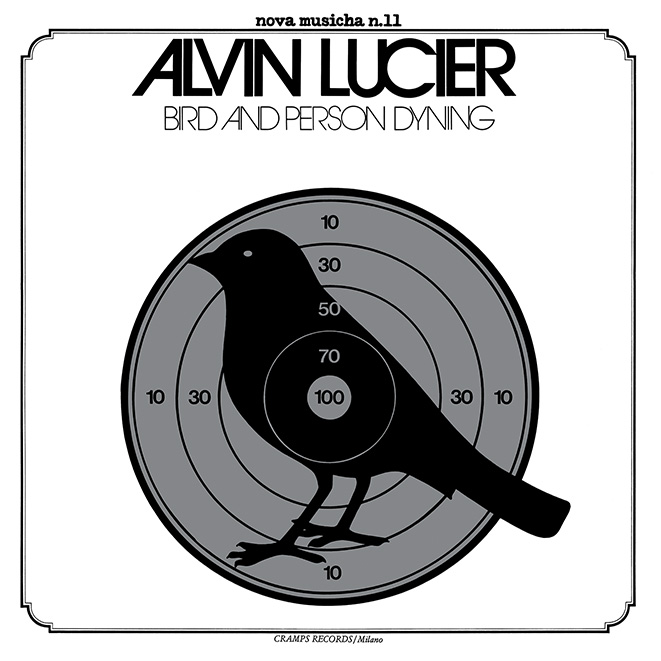
Among these earlier efforts, his first solo LP, Bird and Person Dyning, issued by Cramps in 1976, stands high among the most groundbreaking and important.
Bird and Person Dyning comprised two incredible pieces from this phase in Lucier’s career, The Duke of York and the title track, each taking up a single side of the LP. The first, The Duke of York, is built around the human voice and drew its early inspiration from Lucier’s dream to build a grotesque jukebox to create a real-time collage of the cultural imprints of popular sound.
In the composer’s own words, “A single performer chooses and determines the order of an indefinite number of whole songs, speeches, arias, selected excerpts from books, letters, poems, films, plays, TV series or any other vocal sounds, including non-human ones. The actual duration of these sounds is altered by one or more people using synthesisers or other electronic tools, basing their choices on memories or similar experiences. Once altered, for example through a filter, the example can no longer be undone, and other changes must be made to the previous examples.”
The final effect, as it evolves over the duration of the piece, is a stunning collision of vocal fragments, almost seeming to swim against the increasing tide of synthetic intervention and electronic sound, slowly becoming subsumed and transformed in a raw, unrecognizable materiality itself.
Bird and Person Dyning, taking up the second side, is a groundbreaking work that lays important foundations for Lucier’s life long exploration of sound in space, its relation to the body, and the generative possibilities of close pitches, in this case exploring the sounds of an electronic bird as they resonate inside of the head and in the ear canals.
As he describes it in the album’s liner notes, “I began experimenting by moving the sounds of the bird between two speakers, listening to them through the two mini microphones inserted in my ears, as I walked slowly through the space between the two speakers. The amplified chirps moved left and right according to my movements, creating small time delays and phase-shifts in relation to the position of the motionless bird. Sometimes the microphones would resonate with the loudspeakers, thus generating a Larsen feedback, and I could control the timbre and volume with small head movements […]. A performance of Bird and Person Dyning is a live exploration of these phenomena.”
The outcome is unlike anything in the history of recorded music prior to it, a tense effort of minimal materiality that maximizes its possibilities to monumental terms, shifting and spatializing tones and electronic sounds producing a previously unencountered world.
As important as reissues come, the seminal document from early in Lucier’s career is released by Dialogo in a limited edition of 300 copies on black vinyl, with fully remastered audio, housed in a gatefold sleeve that beautifully reproduces the original design, complete with brand new English translations of the original liner notes. Impossible to recommend enough.
The compositional style of these three pieces is the result of work with the improvisation group F& W Hat.This was formed in 1972 at the University of York by Jan Steele, pianist Dave Jones and flutist Mike Dean.
BUY
Digital
The group was directed towards playing a very quiet, repetitive form of improvised rock-based music, a principle which has to some extent survived in these compositions.
All Day
All day I hear the noise of waters Making moan Sad as the seabird is when going Forth alone He hears the winds cry to the waters’ Monotone.
The grey winds, the cold winds are blowing Where I go. I hear the noise of many waters Far below. All day, all night, I hear them flowing To and fro.
(From ‘‘Chamber Music’’ by James Joyce, 1907 No. XXXV)
“All Day” was written for the York University Pop Music Project of 1972. It arose from a long study of Debussy’s opera Pelléas et Mélisande and the method of word setting is a direct result of this. The words are a lyric by James Joyce from Chamber Music 1907. The harmonic and general style are again derived from the playing of F & W Hat. In structure it is a 12-bar blues with a short interlude over which the guitar-solo takes place.
Distant Saxophones ‘‘Distant Saxophones’’ was composed primarily as a didactic piece, an attempt to describe the kind of improvised music envisaged. The piece is particularly addressed to Dominic Muldowney, who plays the viola solo. It was first performed in 1972 by the then-reformed F & W Hat and consists of material from a rejected 1969 composition and new material in imitation of the style of improvising which the group had by then evolved, especially the harmonic style of Dave Jones.
Rhapsody Spaniel ‘‘Rhapsody Spaniel’’ also began life as a composition for F & W Hat, but by that time the group had moved away from the possibility of incorporating composed material. Rhapsody Spaniel was eventually completed as a piece for 2 players at one piano in April 1975.
Like Beethoven’s, Cage’s work to date can be conveniently divided into three periods. He is best known for the aesthetic and (to a lesser extent) the music of his middle period: chance procedures, indeterminacy; the supposed liberation of sound, the composer, the performer and the listener from traditional stereotypes and limitations; the acceptance of noise and environmental (non-intentional) sounds into music; the redefinition of musical space and time; the abandonment of the fixed reproducible musical object in favour of quasi-natural processes, etc. This period runs from around 1950, when Cage first began using chance operations, through to 1969 when he made his note-for-note recomposition of the melodic line of Satie’s ‘‘Socrate’’ in the form of ‘‘Cheap Imitation’’.This piece links third and first periods both technically – the return to fully-notated, modal, monodic time-objects – but also circumstantially. Cage gave the first performances of ‘‘Experiences No. 1’’and ‘‘In a Landscape’’ in a concert of his own work during his summer course at Black Mountain College, North Carolina, in August 1948. His other 25 concerts were devoted to the performance of all the works of Satie he could lay his hands on. Cage delivered a lecture to introduce (or justify) the Satie series, and in it one finds the fullest explanation of the methods of structuring that Cage evolved in his earlier music. He pointed out that ‘In the field of structure, the field of the definition of parts and their relation to a whole, there has been only one new idea since Beethoven. With Beethoven the parts of a composition were defined by means of harmony. With Satie and Webern they are defined by means of time lengths. . . . Before Beethoven wrote a composition, he planned its movement from one key to another – that is, he planned its harmonic structure. Before Satie wrote a piece, he planned the lengths of its phrases’. This in fact was Cage’s method in his early period. And, like ‘‘Idyllic Song’’ of 1945 – Cage’s first use of ‘‘Socrate’’, four of the five pieces on this record were based on dance structures, which provided him with the basis ‘for a study of numbers with which I find it congenial to begin a musical composition’.
‘‘Experiences Nos 1 and 2’’ (1945-48) were written in the rhythmic structure of a dance by Merce Cunningham; ‘‘Forever and Sunsmell’’ (1942) ‘follows the phraseology’ of the dance of the same name by Jean Erdman for which it was composed (and first performed at the Studio Theatre, New York City, on 21 October 1942 by Vivian Bower, mezzo, and John and Xenia Cage, percussionists). ‘‘In a Landscape’’, the most extended of these five pieces, uses the most common method of rhythmic structuring that Cage developed during the 30s and 40s.
It is based on the square root principle whereby the larger parts have the same proportion to the whole as the smaller parts have to the larger. For this piece Cage uses a rhythmic structure of 15 x 15 (5.7.3).Thus the piece has 15 15-bar sections which are grouped in three batches of 5, 7 and 3 sections (though this division may not be apparent to the listener, since the sections are made to overlap by means of anacrusis, and since the new slow octave theme in the high register introduced about a third of the way through the piece is the last section of the 5 group rather than the first of the 7 as one might expect). Similarly on the small scale each 15-bar section is built from three phrases, of 5, 7 and 3 bars in length.
The rhythmic structure principle represents Cage’s major achievement in his earlier music. This principle was of course, extended and modified in his chance and indeterminate music: in 1958 Cage wrote that ‘In contrast to a structure based on the frequency aspect of sound, tonality, that is, this rhythmic structure was as hospitable to non-musical sounds, noises, as it was to those of the conventional scales and instruments.
For nothing about the structure was determined by the materials which were to occur in it; it was conceived, in fact, so that it could be as well expressed by the absence of those materials as by their presence.’ Melodically all five pieces use limited, fixed gamuts of notes. ‘‘Experiences No 1’’ for two pianos employs an A minor-ish pentatonic scale, A C DEG as does ‘‘Experiences No 2’’, whose melodic line closely resembles that of‘‘Experiences No1’’. ‘‘The Wonderful Widow of Eighteen Springs’’ for voice and piano was written in 1942, commissioned by the mezzo Janet Fairbank. Cage has. said that no rhythmic structure or method was consciously employed in this composition.
All the elements of the melodic line and its percussive accompaniment resulted from impressions received from the text. The piano is treated as a non-pitched percussion instrument not by inserting objects between its strings (as with the prepared piano) but by using its wooden surfaces.
The pianist is asked to close a grand piano completely (strings and keyboard) and the notation indicates whether the under part of the piano structure, the front or back and upper part of the keyboard-lid or the top of the piano is to be struck, with the fingers or knuckles of the right or left hand.
The voice production is without vibrato, as in folk-singing, and the melodic material consists simply of permutations of the notes A B and E, though in order to employ a low and comfortable range, the singer is permitted to make any transposition of the written notes. ‘‘Forever and Sunsmell’’, song with percussion duet was also written in 1942, and is a setting of a text taken from ee cummings.
The percussion instruments used are two large tom toms (played first with timpani sticks, later with fingers) and a large suspended chinese cymbal of at least 24 inches in diameter.
The song is in two parts (the first dramatic, the second lyrical, according to Cage) connected by an unaccompanied hummed interlude.
The first section itself is in two parts, the first (unaccompanied) using only the notes G and D and a solitary E, the second uses only D and E (later chromatically inflected), ending on an ‘indefinite pitch and unmusical timbre’.
The hummed episode is a pentatonic D EGA B, which (minus the E) is the scale employed for the (accompanied) first part of the second section.The ending of the piece parallels the opening, adding two extra notes, A and E. ‘‘In a Landscape’’ for piano (or harp) solo is the most involved melodically as it is structurally. Cage asks for both pedals to be kept down throughout and despite the presence of almost continuous ‘unaccompaniment’ figuration, this piece, too, is essentially monodic. Its quite elaborate fixed gamut of notes is a pentatonic scale, DFGAC, with two added semitones – a B flat (used consistently below middle C) and a B natural (used above middle C).
Michael Nyman
Experiences No. 2 The text is from III, one of Sonnets-Unrealities of Tulips and Chimneys by ee cummings. The two last lines have been omitted. Other lines and a word have been repeated or used in an order other than that of the original.The humming passages (not part of the poem) are interpolations. The original poem is as follows:
it is at moments after i have dreamed of the rare entertainment of your eyes when (being fool to fancy) i have deemed
with your peculiar mouth my heart made wise; at moments when the glassy darkness holds
the genuine apparition of your smile (it was through tears always) and silences moulds such strangeness as was mine a little while;
moments when my once more illustrious arms are filled with fascination, when my breast wears the intolerant brightness of your charms:
one pierced moment whiter than the rest
– turning from the tremendous lie of sleep i watch the roses of the day grow deep.
The Wonderful Widow of Eighteen Springs (the words of this song are adapted from page 556 of James Joyce’s Finnegan’s Wake)
night by silent sailing night isobel wildwood’s eyes and primarose hair, quietly, all the woods so wild, in mauves of moss and daphnedews, how all so still she lay, neath of the whitethorn, child of tree, like some lost happy leaf, like blowing flower stilled, as fain would she anon for soon again ’twill be, win me, woo me, wed me, ah! weary me! deeply, now evencalm lay sleeping; night; Isobel, sister Isobel, Saintette Isobel, Madame Is a Veuve La Belle.
Forever and Sunsmell The title and text of ‘Forever and Sunsmell’ are from 26, one of 50 poems (1940) by e e cummings. Some lines and words have been omitted, others have been repeated or used in an order other than the original.The humming and vocalise (not part of the poem) are an interpolation.The original poem is as follows:
wherelings whenlings (daughters of if but offspring of hope fear sons of unless and children of almost) never shall guess the dimension of
him whose each foot likes the here of this earth
whose both eyes love this now of the sky
– endlings of isn’t shall never begin to begin to
imagine how (only are shall be were dawn dark rain snow rain -bow & a
moon ’s whis- per in sunset
or thrushes toward dusk among whippoorwills or tree field rock hollyhock forest brook chickadee mountain. Mountain) why coloured worlds of because do
not stand against yes which is built by forever & sunsmell (sometimes a wonder of wild roses
sometimes) with north over the barn
credits released December 1, 2023
‘‘VOICES AND INSTRUMENTS’’
Side One
JAN STEELE
ALL DAY Janet Sherbourne: Voice. Stuart Jones: Solo guitar. Fred Frith: Guitar. Kevin Edwards: Vibraphone. Steve Beresford: Bass guitar. Phil Buckle: Percussion.
DISTANT SAXOPHONES Jan Steele: Flute. Utako Ikeda: Flute. Dominic Muldowney: Viola. Steve Beresford: Bass Guitar. Martin Mayes: Piano. Arthur Rutherford: Percussion. (Loaned by Dept. of Music, University of York)
RHAPSODY SPANIEL Jan Steele & Janet Sherbourne: Piano.
Side Two
JOHN CAGE
EXPERIENCES NO. 1 Richard Bernas: Piano duet.
EXPERIENCES No. 2 Robert Wyatt: Voice.
THE WONDERFUL WIDOW OF EIGHTEEN SPRINGS Robert Wyatt: Voice. Richard Bernas: Percussion.
FOREVER AND SUNSMELL Carla Bley: Voice. Richard Bernas: Percussion.
IN A LANDSCAPE Richard Bernas: Solo piano.
Recorded at Basing St. Studios, London. Engineered by Rhett Davies & Guy Bidmead.
Go Dugong is back on Hyperjazz Records! The new album “Meridies” is the result of his ongoing investigative work into traditional Apulian music from the south of Italy, inspired by his hometown, Taranto, and the phenomenon of the Tarantella – started with TRNT (2019, Hyperjazz).
BUY
12 LP “VINYL
Digital
On a quest to push the boundaries of traditional Apulian music, Go Dugong’s research has allowed him to rethink and rework these musical traditions of his homeland, leading to the creation of a soundtrack for an imaginative and futuristic ensemble of peasants and farmers.
In “Meridies” Go Dugong has collaborated with numerous musicians in order to combine traditional Apulian music with sounds and influences belonging to other Italian and Mediterranean regions, reinterpreting a genre that for many years has lived trapped in its canons.
For Hyperjazz Records, “Meridies” represents another fundamental step in the reinterpretation of the rhythmic and musical tradition of Southern Italy, filtered through electronic synthesis and contemporary languages.
Rhythmic pizzica interweave with organs, old synthesizers, lysergic guitars, and makeshift objects such as old cardboard boxes and cookware, used as side percussions to the traditional tambourine, all immersed in a psychedelic magma of deep trance and hypnosis for the purpose of “healing”.
Following the release of Sacred Love, the second album by Galathea, Massimo Napoli—just as he did with the acclaimed Samba De Sausalito—returns with four brand-new, unreleased tracks.
BUY
12″EP VINYL
Released on a 12″ vinyl by Space Echo, the Ancestral EP is a journey through sound that blends tradition and innovation.
The opening tracks, Ancestraland Karimabao, immerse the listener in mystical, hypnotic atmospheres.
Here, Napoli crafts a mesmerizing alchemy of African rhythms and pulsating contemporary electronics, creating a unique sonic blend tailored for the most refined and adventurous dancefloors.
With Africa Carnival, the groove takes a vibrant Afrobeat direction, but there’s an unmistakable Brazilian flair woven throughout.
Mario Pappalardo’s masterful keyboard work infuses the track with rich jazz and funk undertones, evoking the spirit of José Roberto Bertrami’s iconic Jazz Carnival from the legendary Brazilian group Azymuth.
BUY
12″
CD
DIGITAL
The EP closes with Sacred Club, a track that invites both movement and reflection. Designed for a more intimate dancefloor, it pulses with subtle spiritual overtones and echoes of African mysticism—an understated yet compelling finale to an evocative collection.
This was how Piero Umiliani himself described Piano Fender Blues, an album entirely recorded using two electric pianos (the iconic Fender Rhodes, of course, and a Wurlitzer), along with bass, acoustic piano, drums, and percussion.
It stands as yet another curious detour for the Florentine composer, one that ventures beyond his better-known realms of jazz, film soundtracks, and more avant-garde experimentation.
BUY
12″LP VINYL
CD
DIGITAL
As its title candidly suggests, Piano Fender Blues is a straightforward and unpretentious work. The melancholic tone of the American electric piano pairs effortlessly with a lighter, more relaxed repertoire—what one might nostalgically refer to as easy listening.
It’s an album that fits neatly into Umiliani’s more carefree and accessible catalog, alongside titles like Atmospheres, Fischiando in Beat, or Motivi Allegri e Distensivi—a testament to the composer’s extraordinary versatility.
Originally released in 1975 under the pseudonym Rovi, Piano Fender Blues combines refined instrumental technique with a sound that unmistakably reflects its era.
It enriches the vast library of production music—those so-called “library records”—that made Umiliani just as legendary as his ventures into jazz and cinema.
Piero Umiliani’s musical attention was not directed solely toward distant Africa, its percussive soundscapes, and unexplored territories—as evidenced by the remarkable duo of Africa and Continente Nero.
BUY
12″ LP VINYL
CD
DIGITAL
The Maestro was a true voyager, not just in the physical sense, but through a long series of geographically themed albums that remain some of the finest works in his prolific and tireless career.
His vast and intricate discography—recorded under his own name, in solo projects, with ensembles and orchestras, or through a variety of aliases such as Rovi, M. Zalla, The Soundwork Shoppers, Moggi, and Catamo— includes a series of remarkable sonic journeys through time and space.
Albums like Genti e Paesi del Mondo, Paesi Balcanici, Il Mondo dei Romani, Storia e Preistoria, Medioevo & Rinascimento, Panorami Italiani, and Paesaggi showcase a boundless creative drive.
In them, Umiliani blends his deep-rooted connection to Italian history and traditions with the sounds of the wider world—and even beyond, in his cosmic explorations such as Tra Scienza e Fantascienza and L’Uomo nello Spazio.
Among his most adventurous sonic expeditions, Polinesia deserves special mention.
Built entirely on vibrant percussion and exotic atmospheres in the style of Martin Denny, it evokes sun-drenched white beaches, the dreamlike South Pacific, and the legendary Bora Bora—described by Italian writer and documentarian Folco Quilici as “the most beautiful island in the world.”
So mix yourself a colorful cocktail, sit back, and let the full moon rise. The soundtrack is right at your fingertips.
In the complex and evocative world of Italian library music, the themes of the city, industry, urban life, labor, and technology have always held a special allure.
BUY
12 LP “VINYL
CD
Digital
These motifs have inspired dozens of essential records by composers like Alessandro Alessandroni, Farlocco, Gerardo Iacoucci, A.R. Luciani, Narassa, and many others.
Especially during the rapidly changing and turbulent 1970s, the attempt to create a plausible soundtrack for a society in constant flux often gave rise to masterpieces—works that fused avant-garde techniques with found sounds, daring experiments with lighter compositions, the chaos of traffic and factory noise with the silence of night, the end of a work shift, or the quiet calm of a Sunday afternoon.
Within this rich and multifaceted tradition lies L’uomo e la città by Piero Umiliani. Here, the Maestro is joined by a sublime ensemble of jazz musicians, including heavyweights such as Bruno Tommaso, Oscar Valdambrini, Dino Piana, and Nino Rapicavoli. Together, they bring to life a sound that leans heavily on the richness of brass and the rhythmic interplay of the ensemble, all under Umiliani’s refined direction
L’uomo e la città may be less audacious than some of Umiliani’s more experimental outings, but it gains in coherence and jazz sophistication.
Tracks like Rete Urbana, Quartieri Alti, and Città Frenetica showcase a masterful balance and drive.
Yet the album still knows how to surprise—suddenly and brilliantly—with two stunning versions of Centrale Termica and the standout Suoni della città, among the album’s highest peaks.
Per fornire le migliori esperienze, utilizziamo tecnologie come i cookie per memorizzare e/o accedere alle informazioni del dispositivo. Il consenso a queste tecnologie ci permetterà di elaborare dati come il comportamento di navigazione o ID unici su questo sito. Non acconsentire o ritirare il consenso può influire negativamente su alcune caratteristiche e funzioni.
Funzionale
Always active
L'archiviazione tecnica o l'accesso sono strettamente necessari al fine legittimo di consentire l'uso di un servizio specifico esplicitamente richiesto dall'abbonato o dall'utente, o al solo scopo di effettuare la trasmissione di una comunicazione su una rete di comunicazione elettronica.
Preferenze
L'archiviazione tecnica o l'accesso sono necessari per lo scopo legittimo di memorizzare le preferenze che non sono richieste dall'abbonato o dall'utente.
Statistiche
L'archiviazione tecnica o l'accesso che viene utilizzato esclusivamente per scopi statistici.L'archiviazione tecnica o l'accesso che viene utilizzato esclusivamente per scopi statistici anonimi. Senza un mandato di comparizione, una conformità volontaria da parte del vostro Fornitore di Servizi Internet, o ulteriori registrazioni da parte di terzi, le informazioni memorizzate o recuperate per questo scopo da sole non possono di solito essere utilizzate per l'identificazione.
Marketing
L'archiviazione tecnica o l'accesso sono necessari per creare profili di utenti per inviare pubblicità, o per tracciare l'utente su un sito web o su diversi siti web per scopi di marketing simili.